

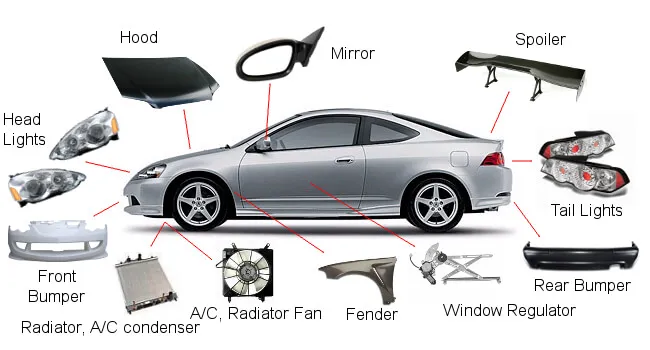
Car Parts Names, Whether you’re a car enthusiast, a new driver, or simply someone trying to understand what your mechanic is talking about, knowing common car parts names can be incredibly useful. This guide breaks down the essential components of a vehicle, grouped by category, to help you get familiar with what’s under the hood — and beyond.
1. Engine and Related Components
The engine is the heart of your vehicle. Here are the main car parts names associated with the engine:
- Engine Block: The core of the engine, housing cylinders and other components.
- Cylinder Head: Sits atop the engine block, containing valves and spark plugs.
- Camshaft: Controls the opening and closing of the valves.
- Crankshaft: Converts linear piston motion into rotational force.
- Timing Belt/Chain: Coordinates the engine’s internal moving parts.
- Spark Plugs: Ignite the air/fuel mixture to power the engine.
- Oil Filter: Cleans engine oil to protect internal parts.
- Radiator: Cools engine coolant to prevent overheating.
- Water Pump: Circulates coolant through the engine.
2. Transmission System
This system transfers power from the engine to the wheels:
- Transmission: Controls gear shifts, either manually or automatically.
- Clutch: Connects and disconnects the engine from the transmission (manual cars).
- Drive Shaft: Transfers torque from the transmission to the wheels.
- Differential: Allows wheels to rotate at different speeds while turning.
3. Suspension and Steering
These parts ensure a smooth and controlled ride:
- Shock Absorbers: Dampen the impact of road irregularities.
- Struts: Combine a shock absorber and a coil spring in one unit.
- Control Arms: Connect suspension to the vehicle frame.
- Steering Rack: Converts steering wheel motion into wheel movement.
- Tie Rod Ends: Help move the wheels when steering.
4. Braking System
Vital for safety, the braking system includes:
- Brake Pads: Press against rotors to stop the car.
- Brake Rotors/Discs: Spin with the wheels; slowed by the pads.
- Brake Calipers: Squeeze the brake pads onto the rotors.
- Brake Lines: Carry hydraulic brake fluid.
- Master Cylinder: Creates pressure in the brake system.
5. Electrical and Lighting System
Modern cars rely heavily on electrical components:
- Battery: Powers the car’s electronics and starts the engine.
- Alternator: Charges the battery while the engine runs.
- Starter Motor: Cranks the engine to start it.
- Headlights/Taillights: Provide illumination and visibility.
- Fuses and Relays: Protect and manage the electrical circuits.
6. Interior and Comfort Features
Comfort and convenience come from these components:
- Dashboard: Houses controls and displays like the speedometer.
- Air Conditioning (A/C) System: Regulates cabin temperature.
- Seats and Seatbelts: Provide comfort and safety.
- Infotainment System: Offers audio, navigation, and connectivity.
7. Exterior and Body Parts
The visible parts of a car include:
- Hood: Covers the engine compartment.
- Bumper: Protects the front and rear ends of the car.
- Fenders: Frame the wheel wells.
- Grille: Allows air into the engine bay.
- Mirrors: Assist with visibility.
Final Thoughts
Understanding basic car parts names helps you communicate better with mechanics, perform simple maintenance, and gain confidence as a vehicle owner. While modern cars are complex machines, breaking them down by their systems makes learning much easier. Whether you’re troubleshooting a problem or just exploring how your car works, familiarizing yourself with these names is a great first step.
You Might Also Like These: